Showing posts with label sweden. Show all posts

18 June 2019

Kayaking in Möjareservatet

After moving out of Sweden in 2015, I've missed the Stockholm archipelago a lot. There’s nothing quite like it in Europe outside of Scandinavia and British Isles.

Me and Chillu went to my favorite part around the island of Möja. In the beginning of June there were very few people out there, so it was very quiet. As usual, Stockholm archipelago offered the best accommodation for the lowest price of 0 SEK.

The best accommodation is often free

Sunset seen from my sleeping bag

After sunset, as seen from Chillu's sleeping bag
This was our route on the first day (the time and elevation shown by Strava are wrong though).


Slalom around the small islands avoids the open sea, which makes it less windy and more pleasant. Also, the small islands and channels between them are more beautiful than the open sea.

Calm waters in Bockösundet, a channel between two islands

Enough with the words, for more photos you can go to Flickr or Google Photos (a bigger album from two cameras).

24 November 2015

Swedish summer 2015

People said this was the rainiest Swedish summer ever, but I disagree. I slept 5 times in the Stockholm archipelago and each time without a tent. This is how we usually slept.

The best hotel in the Stockholm area. Cost: 0 SEK. Experience: priceless. At Angödrommen.
Maybe the weather was nice to me, since this was my last summer in Sweden. Stockholm archipelago, I'm going to miss you!

There is not much to write about all the trips I made, so let the photos speak instead. Don't continue if you are scared of swans, seals, mushrooms, spiders, snakes or dragonflies! A link to a full album is at the end of the post.

Finally getting dark at 11 pm
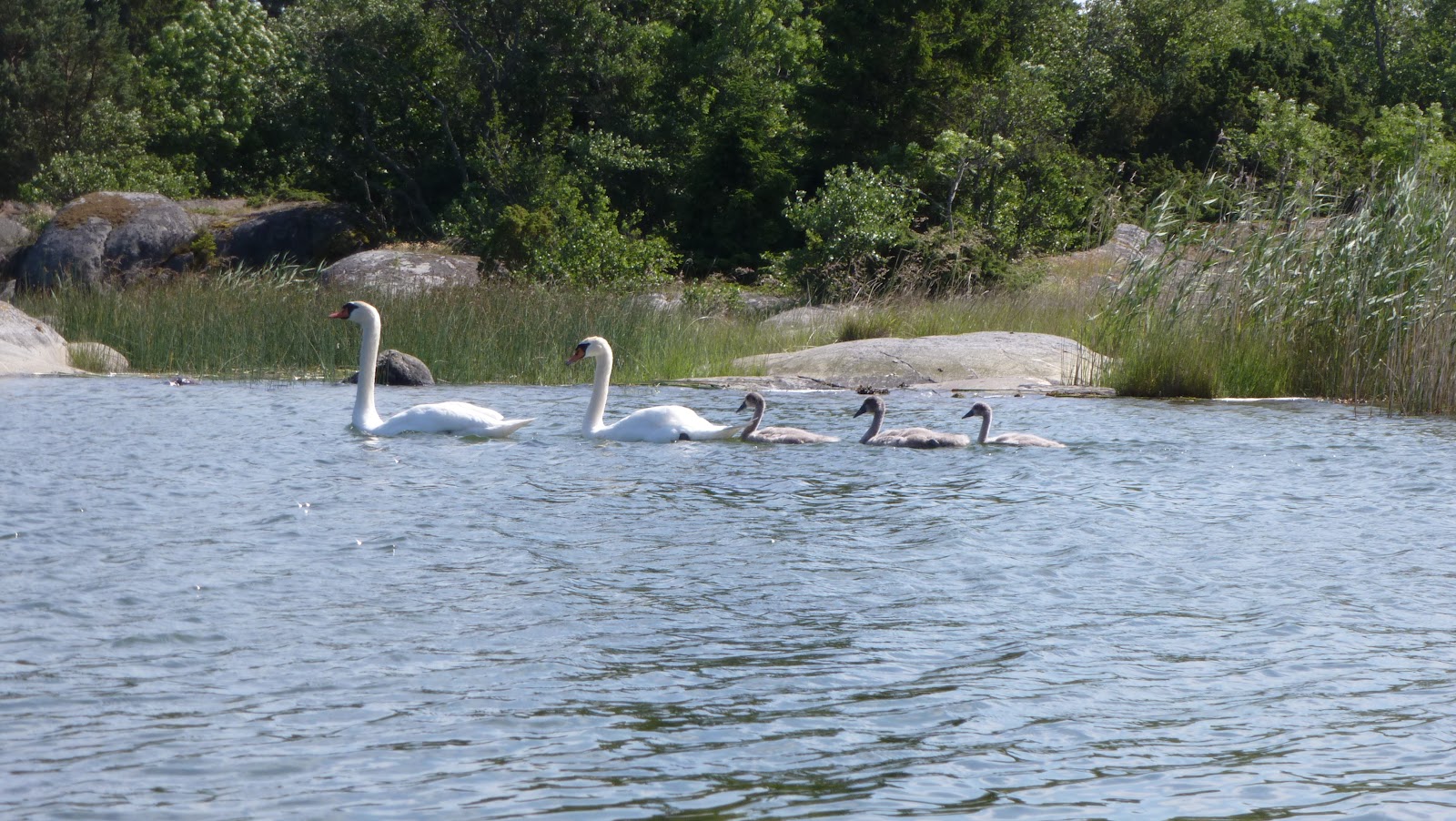
Swan family chose a vacation by the sea
Snake hiding in blueberries
Unknown water creature with many small legs
We thought we wouldn't be able to pass through at first. It turned out to be a channel made for kayaks.
Mirror sunset at Kolkböte
Happy people and happy sheep at Fjärdlång
Lonely mushroom
Dragonfly
We saw seals!
If you want to see even more wild animals, check the full album made from multiple cameras on Google Photos or a small selection of my photos on Flickr.

30 September 2014

Kayaking on a mirror

A couple of months ago me and Benny took a boat from Stockholm to Ingmarsö and then paddled for a couple of hours in the outer Stockholm archipelago. Even though we got soaking wet in the rain, it was a great experience and we had to come back. This time for two days.
The whole trip. We started in the south-west corner and slept on the big island in the north-east corner. About 30 km in total. By the way, the OSM map misses some islands and some are too big.
After two hours of paddling we found an awesome place for camping but we decided to continue a bit farther. And it was worth it, because we found paradise on Earth: Idskär is a small island of size 500 × 200 metres, so it's only inhabited by trees, birds and spiders. There were no mosquitoes or annoying ants. A couple of meters from our private beach was a luxurious thick soft moss where we pitched the tent (I ended up sleeping outside of the tent anyway).
Our private beach on Idskär with our kayaks.
It was still too early, so we went for a short ride before the sunset. The sunset was stunning.
Saturday was without a cloud and with a slight wind, while Sunday was with clouds and without wind. We had to paddle on a mirror.
We also found a very old wooden ship wreck in need of exploring.
This trip has exceeded my already high expectations. Great weather, a lot of solitude and an awesome sunset. I would like to come back as soon as possible but unfortunately the winter is coming.

As always, full album is on Google Photos.

28 April 2014

Why Slovakia and Sweden are two superwealthy countries

According to Wikipedia, "at the most general level, economists may define wealth as anything of value". But what is value?

People mistake price for value. Why would you do that, if you don't plan to sell your stuff? I paid a lot for my skiing and mountaineering equipment, but I would be willing to pay 5 times as much, since it had brought so much fun to my life. And I would feel even more wealthy, if I lived closer to mountains and could use it more often.

Most of my skiing and mountaineering equipment on one pile
On the other hand, I wouldn't pay even 1/10 of the price of some other things, because they have very little value to me. Diamonds are a good example: I have seen more beautiful stones in nature and they are overpriced anyway, thanks to a cartel and heavy marketing.

We also value things that don't have a price attached to them, like friends and family. It's impossible to sell a friendship, yet we benefit a lot from it.
Not everything that can be counted counts, and not everything that counts can be counted. – William Bruce Cameron
If you ask me which countries are superwealthy, I might say 30% of them. The world is a great place right now:
  • Global poverty has been decreasing faster than ever. In 1950, the average American household spent 30% of its budget on food while it's only 13% now (I suspect similar progress in the rest of the world, too).
  • The world is most probably the safest it has ever been. Even with the two world wars, the 20th century was mostly likely the most peaceful century so far. If you were a man in a hunter-gatherer society more than 10 000 years ago, you had about 25% chance of being killed by someone else. This number has been estimated to be at most 3% in the 20th century and it will mostly likely be lower in the 21st century.
  • We live longer and we almost eradicated some diseases through vaccination at some places.
  • Societies around the world are more tolerant and free. A few centuries ago you were stuck in the same social class as your parents. In the 1950's in the US, black people were still subject to heavy discrimination. If you lived in the communist block in 1989, you could not travel out of your country freely.
With so much prosperity and development, it's surprising to me that we keep consuming and working so much. One measure that is not getting better, is happiness and a contributing factor is materialism.
I hope everybody could get rich and famous and will have everything they ever dreamed of, so they will know that it's not the answer. – Jim Carrey
We also keep hearing that we need consumption to keep the economy going, but this is one of the most common economic fallacies. Mr. Money Mustache wrote a great explanation of it in What if Everyone Became Frugal?. The world gets richer by saving, not by consuming.

Slovakia and Sweden are two countries where I have been living permanently, so I know them pretty well. Here are a few reasons why they are superwealthy in my opinion and it has little to do with material wealth.

System for talented students, a point for Slovakia

TopCoder is an American company organizing regular programming competitions. Each person has a rating, similar to the one used in chess or tennis. If you have rating above 2200, you reach red color, which is a status that only about 300 people on Earth have at one time. A couple of years ago, someone made a ranking of countries by the number of red programmers per capita and Slovakia was first. I don't think this is a coincidence.

Slovakia has a great system for talented high schoolers in many scientific disciplines. This tradition started already when Slovakia was part of the Austrio-Hungarian Empire. In the historical rankings of International Mathematics Olympiad, Hungary is number 4 and in International Olympiad in Informatics, Slovakia is number 7. Both countries are very small compared to other countries in top 10 (Russia, China and USA are dominating both).

This system is so great that I decided to contribute 1% of my income forever to Trojsten (thanks Kubo for inspiration). Trojsten is a foundation that organizes competitions and training camps in math, programming and physics for high schoolers. When I was at university, I helped running it, giving back what I got when I was in high school.

Additionally, my alma mater, Comenius University, was very good. Sometimes the talented Swedish high schoolers ask me for school recommendations and I half-jokingly recommend Comenius even before MIT or Oxford. At Comenius you are not swamped with homeworks and projects, so you have plenty of time to do other things, like volunteering or part-time work. Even though the course load was low, we still learned a lot from the courses.

Psychologists claim that children these days spend too much time in organized activites and play too little, leading to underdeveloped social skills and creativity. I think there is too little play even among university students. Some of them spend a lot of time in classroom, while they could be doing something else, learning valuable skills that can't be learned while sitting in the classroom. When we organized our week-long training camps, there was often noone older supervising us. This was our way of playing and we had a lot of fun doing that. In many ways, what I learned there is now more valuable than my formal university education.

As you can see, if you are a talented student in Slovakia, you have plenty of opportunities for development, but unfortunately such system for talents doesn't work in Sweden. For example, the Swedish programming olympiad gets only very little money from the state (33% of my income taxes last year).

I have been told that the reason is the famous Swedish striving for equality. As is often the case, the Swedes get the equality wrong: since we are all equal, there are no talents. Contrary to this statement, the Swedish state supports sports and young talented sportsmen with a lot of money. I have been competing at international level in both sports and programming/math and I think there is very little difference between the two. Talent is very important but you also need to train a lot, you need a good coach and a community of other competitors to stay motivated.

At KTH Royal Institute of Technology in Stockholm, there is such a community for university students with coaches supported by the university. A couple of years ago I invited few high school students living in Stockholm to our trainings at KTH. These students are so talented and hard-working, that they already won the Nordic Championships in programming, beating all university students in Scandinavia, while still being in high school.

Ironically, the Swedish equality ideal only leads to inequality of opportunities. If you are a talented high school student living in Stockholm, you are lucky and can get great coaching and meet other talented programmers. We want to improve this by organizing a training camp where students from the rest of Sweden could come, but getting money for it is hard.

Level of trust, a point for Sweden

Last fall I spent a couple of weeks in Berkeley and one weekend we decided to go to Yosemite. We booked a car and the rental company was supposed to pick us up and drive us to the rental station on the other side of town. They were late, so I called them twice and they promised the car would be there soon. The car didn't arrive, so I called again and it turned out that they were lying to me, the car was not on the way and we had to take a bus instead.

How could anyone lie to me like that? Then I realized that I have been in Sweden for too long. In Scandinavia people don't lie that much and there is little corruption, which leads to trust in strangers and public institutions. Scandinavian countries top the list of countries by the level of trust.

When people don't lie, steal and corrupt, there are very few lawsuits, they don't have to install expensive protection in their houses and the government is more efficient. In the end people are more productive and can work less than in countries with lower trust. Such countries are in fact richer even with a slightly lower GDP.

Slovakia is far behind in this regard but things are improving. During communism corruption was often the only way to get things done, but the number of people giving bribes has been steadily declining for a while.

Nature, points for both

Both countries have amazing nature. Here are two photos made by me for illustration.
My friend Martin and Tatras, the highest Slovak mountain range.
Frozen lake in Tyresta national park. In winter a ski track is prepared on the lake.
Nature has many benefits even though we don't have to pay for using it. You can have a week long camping vacation in the mountains for free, provided you have the right equipment. Such a holiday would be more fun for me than a lazy week on the beach that costs a lot. Spending time outdoors in nature also has many measurable benefits, like improved mood and concentration.

Conclusion

This was a highly subjective list but as I said earlier, each person can define wealth in their own way. For example, the value of the Trojsten community is that it gave me many great memories and valuable friendships. I'm excited to meet many of them in a couple of days in Italy.

15 July 2013

The story of a boy who went to Sweden

Since I was a teenager I was thinking of living abroad. After finishing college I was considering a few options. I knew some Slovaks living in England, Switzerland or USA. In the end I chose Sweden partly because I didn't know anyone here.
When given a choice, choose the thing that scares you a little. – Jeff Atwood
One of the reasons to move here was actually orienteering. It is a sport that is a lot of fun, but unfortunately it's not very popular outside of Scandinavia. I was always dreaming of living here and doing orienteering in some of the world's most challenging terrains. I visited Scandinavia before to practice orienteering and do hiking, and I have been impressed by the beautiful nature and how organized everything was.

Then I applied for some PhD positions and I was accepted as a student by one of the best theoretical computer scientists in history, so Stockholm was clearly the best option for me in the summer of 2009.

I actually started this blog to keep my friends updated about life in Sweden, but I never wrote a post about my view of Sweden. I have been here for a while and I feel like I know Sweden pretty well by now.

Things I like

  • The Swedish language has a beautiful sound, has no grammar and is very easy to learn. It's also very interesting that the word vak means hole in the ice, but to say addictive you need beroendeframkallande, which is 20 letters. Shorter words are usually used more often, so this tells you something about Swedish culture.
  • Swedish humor is very witty, playful and often subtle.
  • Swedish state leaves me alone most of the time. They take away half of my money and the housing system is horrible, but those are about the only times when I notice its presence. Sweden is liberal, you have a lot of personal freedom, there are not many rules to follow and bureaucracy is low. I value the personal freedom more than all the money that is taken away from me.
  • I enjoy working with Swedes. They are very hardworking, pay attention to details and get things done in a timely manner without any stress.
  • It's a beautiful country, forests and water are everywhere. Places like the one on the following picture can be usually found within one hour drive from your home.

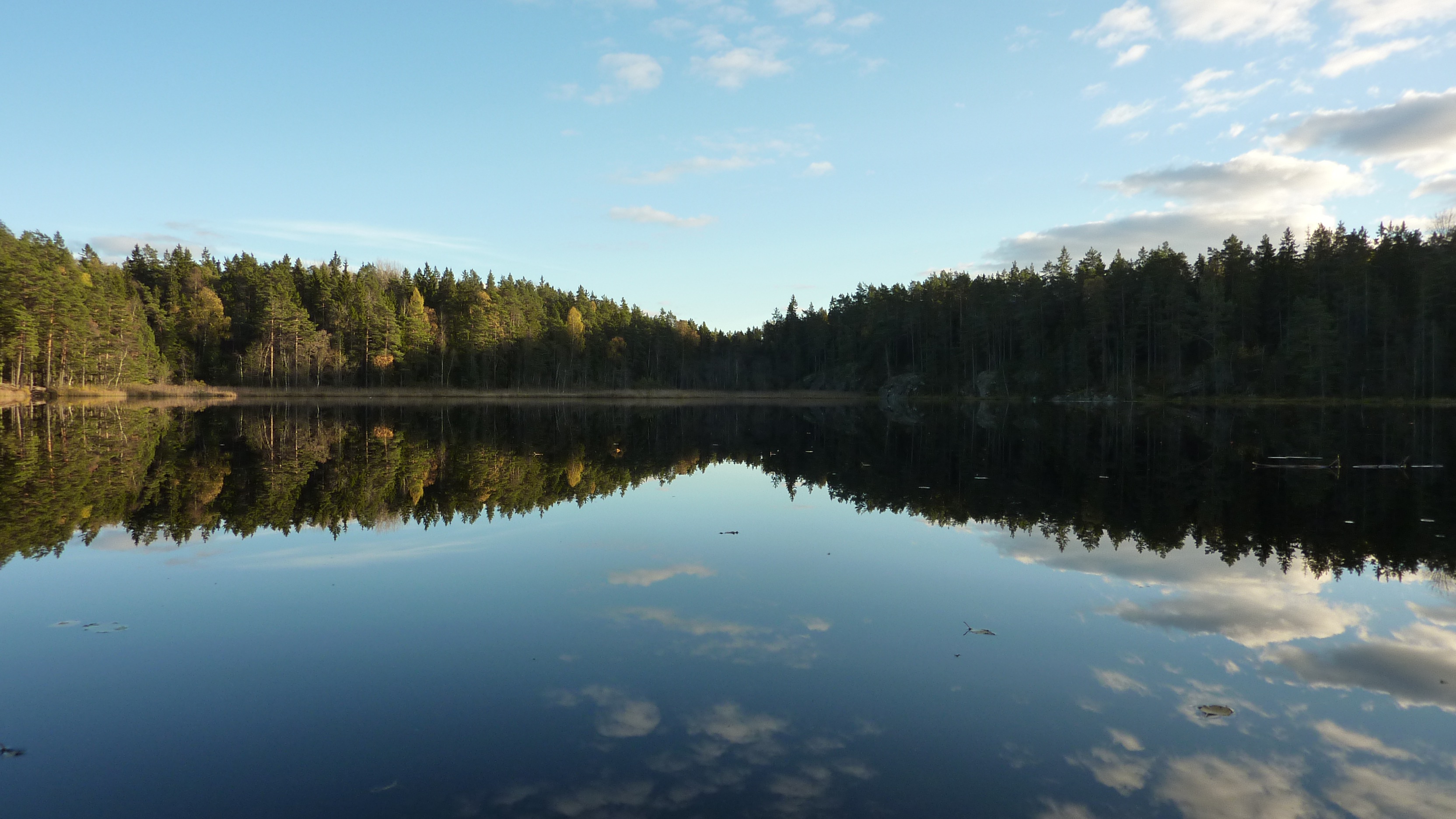
  • A calm day in Tyresta, my favorite place near Stockholm
  • Sweden is an introvert-friendly society, unlike USA for example. Before I came here I read some blogs of Americans living in Sweden and they were basically complaining that Swedes should be more extroverted. I think it's nothing wrong with being introverted and other people think the same.

Thing I don't like

When someone asks me about my least favorite thing about Sweden, my answer usually revolves around the same topic. I call it lack of expressiveness and it has many forms. For example, Swedes don't like conflict and rarely disagree with people. But this goes in the other direction as well. They have trouble showing that they like something or somebody. It is thus very hard to make friends as well as make enemies. There are exceptions of course, for example I like that my supervisor is not afraid to criticize me and I also have a few Swedish friends.

Since I moved to Sweden, I have made about the same number of new Slovak friends as Swedish friends. On the other hand, I think I got into a conflict in Slovakia much more often than in Sweden. It's not uncommon to get into a conflict with a waiter/bus driver in Slovakia for no reason and I don't miss these pointless conflicts here. However, I still think Swedes should express their negative feedback more often.

The lack of expressiveness has effects on the whole society and not just one-on-one interactions. The way people dress is very uniform, nobody wants to stick out and express themselves. Swedes describe themselves using the word lagom, which means just the right amount. The Wikipedia entry for lagom among other things says about the Swedish society:
Nonetheless, it is still widely considered ideal to be modest and avoid extremes.
Another phenomenon explaining the Scandinavian culture is Law of Jante which says
You are not to think you're anyone special or that you're better than us.
However, I have a feeling that this is slowly changing, especially in the big cities people are not that homogeneous and try to be unique in some way.


What I learned

I seldom end up where I wanted to go, but almost always end up where I need to be. – Douglas Adams
I learned that things almost never go as planned. On the other hand they often went much better than planned. I got the honor to teach the best high school and university programmers in Sweden, I got an awesome part-time job at Spotify with a lot of autonomy and there were a few more positive surprises.

Of course there have been some negative surprises, but I have never questioned my decision to move abroad. I learned a lot by being forced outside of my comfort zone. It is hard sometimes, but it's worth it in the long run.

I encourage everyone to try living abroad at least for a while. You will be frustrated and lonely at times, but in the end you will become stronger and a better person. Psychologists claim that the best time for this decision are your twenties, so don't waste your time!

06 April 2013

Kebnekaise, the Arctic journey

In March 2008 me and Kolo hiked for a week in Morocco in High Atlas in altitudes ranging from 2500 to 4000 metres carrying everything we needed in our backpacks. Precisely 5 years later the two of us planned a trip of similar difficulty, a week of ski touring and mountaineering beyond the Arctic Circle near the highest mountain in Sweden, Kebnekaise.

After months of research and preparation I was really excited to go. Well, not so fast! 4 days before we were supposed to leave I got a 40-degree fever and could barely move. Maybe it didn't make sense for Kolo to fly to Sweden from Boston after all. Luckily, just a few hours before his flight the doctor told me that even though I had influenza, I could be skiing on Monday or Tuesday.

We started our trip as planned but the first day I stayed in bed at Kebnekaise fjällstation while Kolo went alone for an easy trip. On Monday I tried to ski but only for 3 hours, since my lungs were now fighting with a secondary bacterial infection and were still very weak.


On Tuesday we decided to go to Tarfala, another mountain hut in the area. The weather was horrible but at least we had the hut and the valley only for ourselves. In the afternoon we went for a ride on Isfallsglaciär. The snow was awesome but the slope was not steep enough for sufficient speed.


According to the forecast, Wednesday was supposed to be without wind. When we woke up, the Tarfala valley was silent. We started climbing towards Kaskasatjåkka (2076 m), but when we reached a saddle at 1800 m, the wind picked up speed again. We skied down in a complete whiteout sometimes not knowing if we were going up or down. Sometimes I hit a small hill but I couldn't see them, because everything was white.


We decided to take a shortcut through Kebnetjåkka lilltopp, ending with a downhill ride right to the doors of Kebnekaise fjällstation. "It's half past one, we have 5 hours to do this", said Kolo. I laughed, because it looked like 2 easy hours. Little did I know what was going to happen next. After we reached a plateau the wind got so strong it was difficult to maintain balance while standing. It must have been between 60 to 90 km/h, no wonder this is the windiest place in Sweden with a record of 292 km/h (and then the station broke). We turned around for the second time today and continued in the valley with less wind. We reached the hut just before six.


Thursday was the last possible day for ascending Kebnekaise sydtopp (ca. 2110 m), the highest mountain in Sweden. The weather was great, clear sky and almost no wind, so we made it without big problems. The view from the top was simply breathtaking.


Countless stones made the descent harder, but at least I trained skiing in 3-meter narrow snow fields surrounded by stones. After the hard part we were rewarded with a ride in an awesome powder just below Tolpagorni. After climbing 1800 height meters and 9.5 hours we were back at Kebnekaise fjällstation. This was one of the hardest day trips I have ever done and my lung infection and temperature between -10 and -15 degrees didn't make it easier.


On Friday morning I woke up completely exhausted and still coughing too much, so Kolo went alone for a ride in the sunny weather.


Finally it's time to go home after a week long Arctic experience. We will be back!

A small selection of photos is on Flickr and a full album on Google Photos.